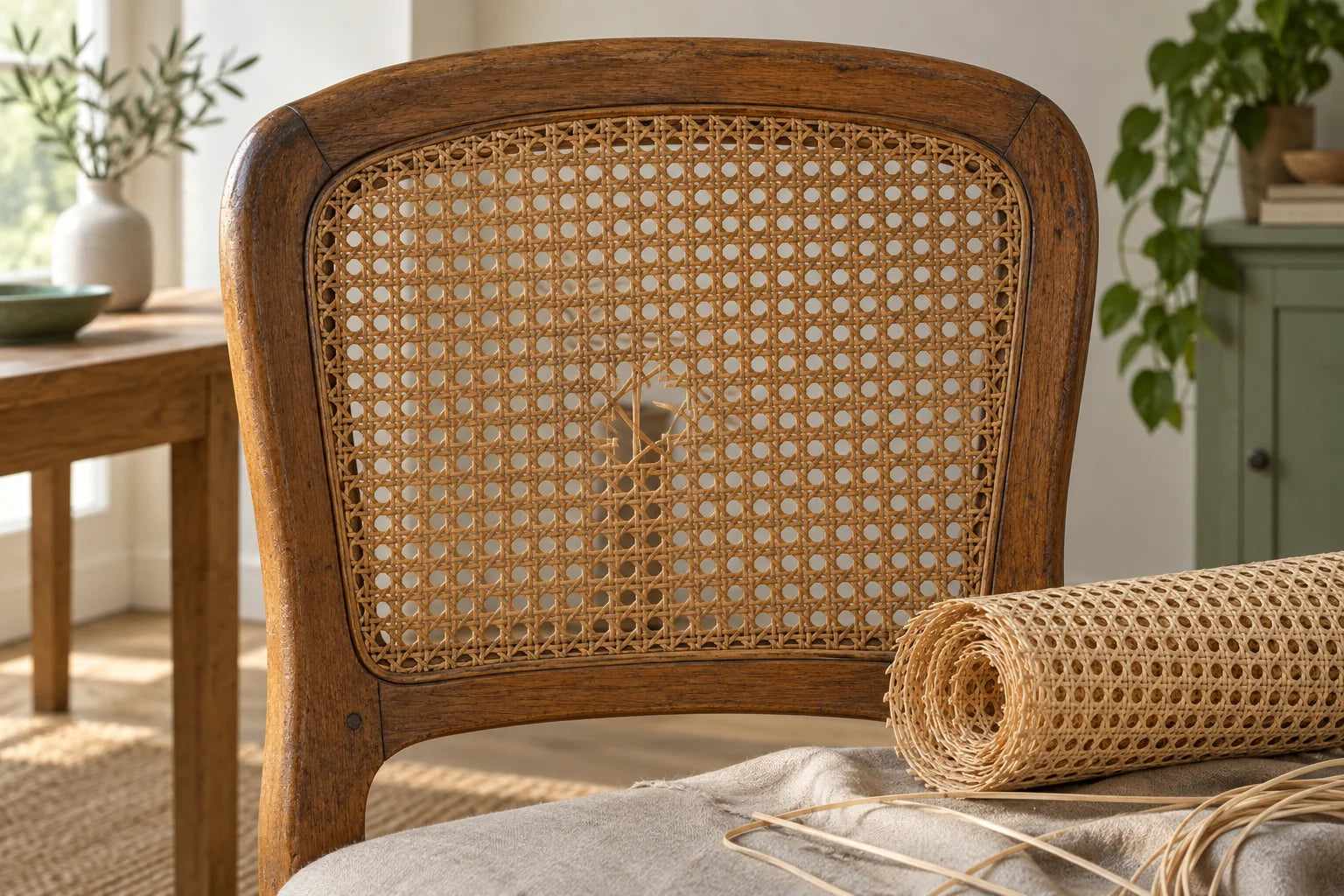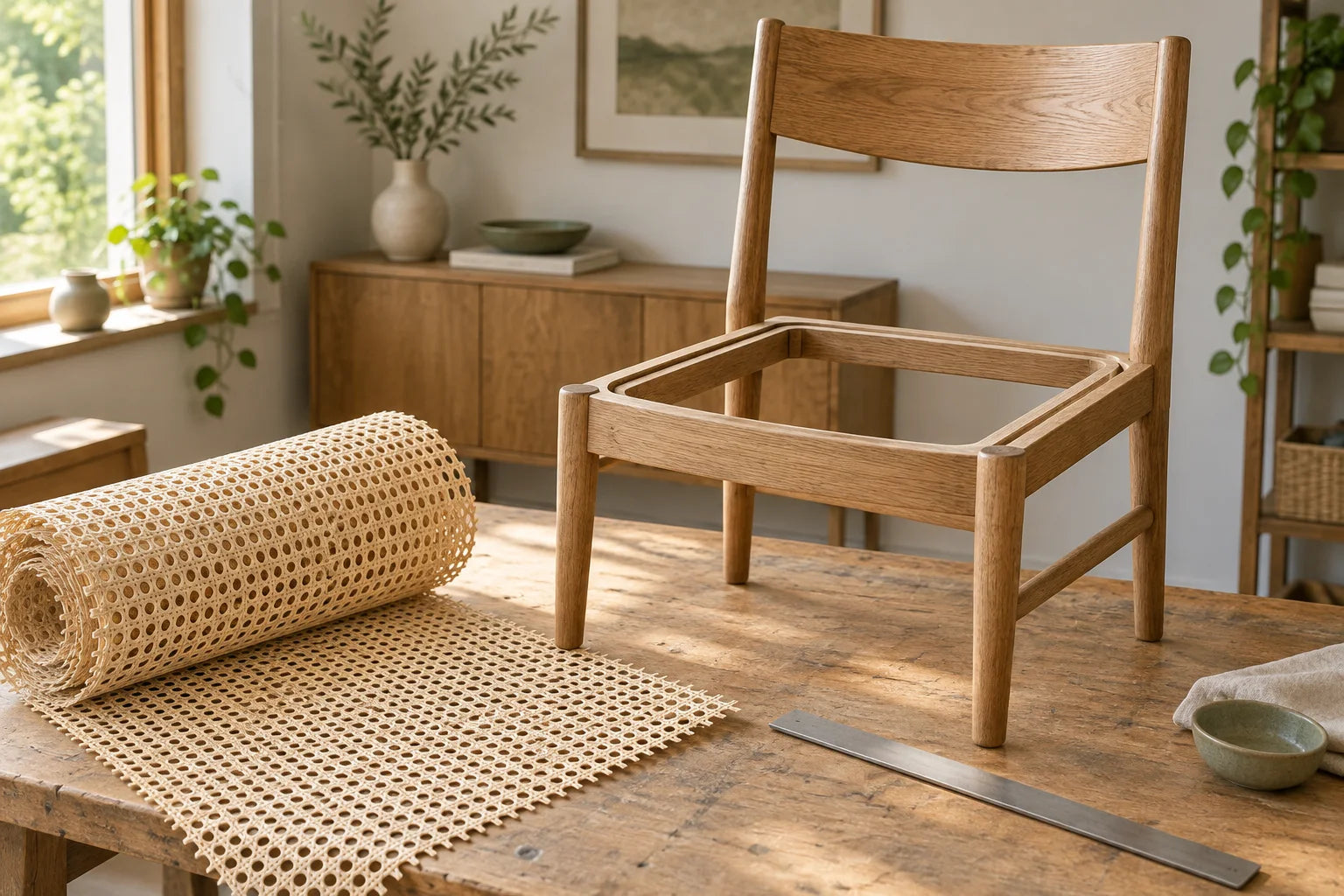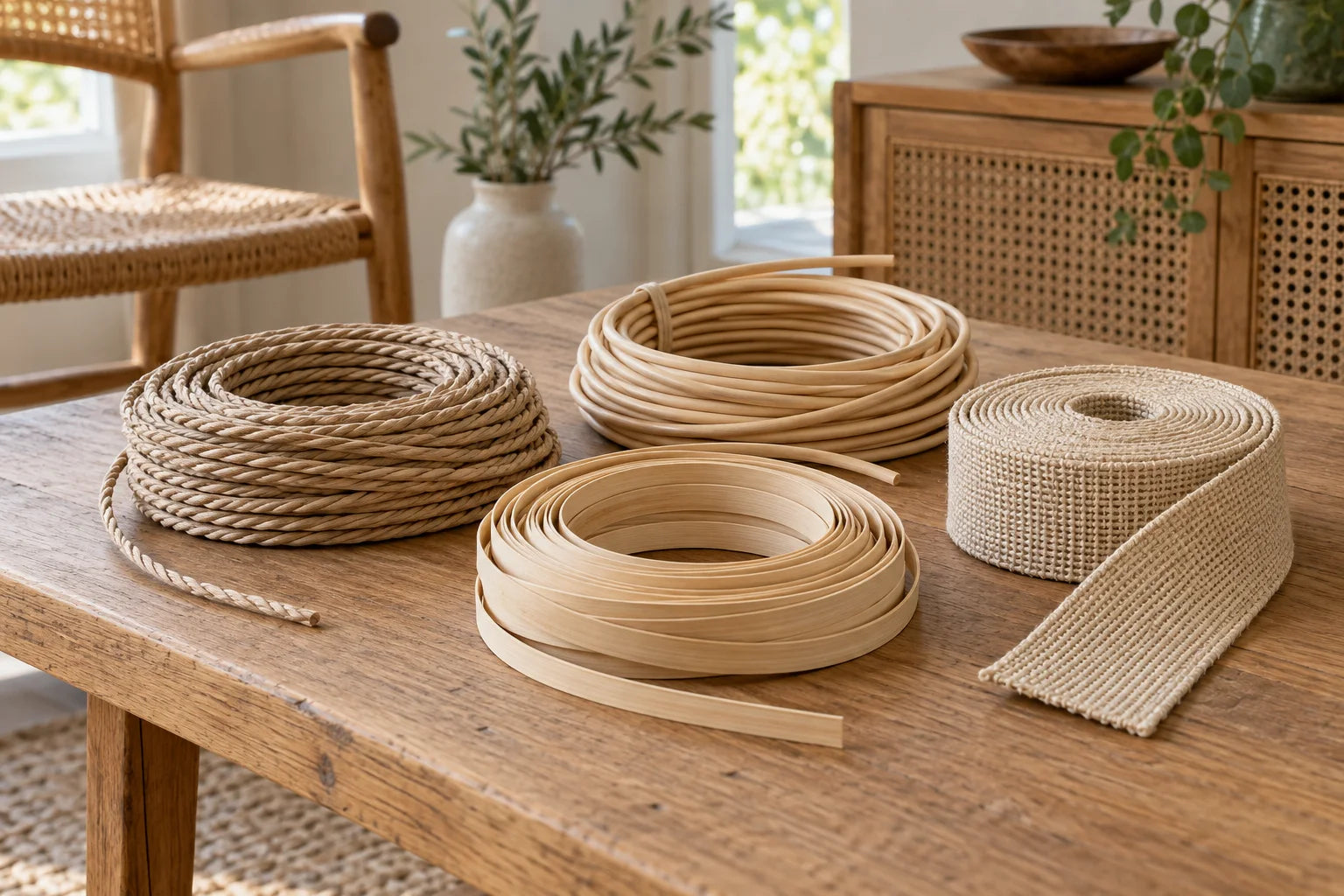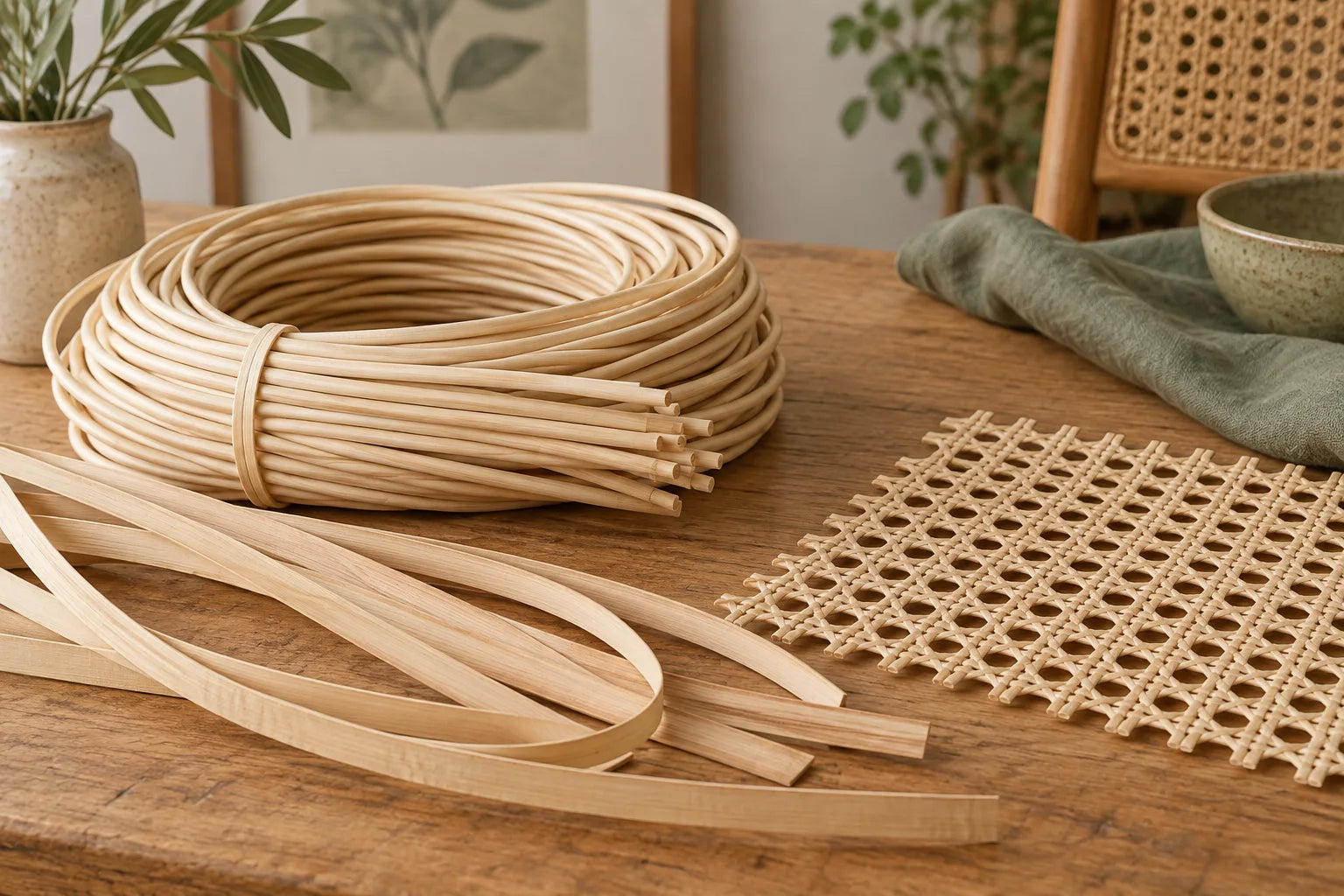
Rattan core cane is the round, flexible weaving material from the inside of the rattan stem, often called “peddigrør” in Danish. Rattan is the broader material name. Flat cane strips and pre-woven sheets look different and may be used in other constructions.
For chair weaving it is therefore more useful to show the material's form and attachment than merely calling everything "rattan".
Look at the cross-section and surface
Is the material round like a thin rod, flat like a strip, or twisted like yarn? Does it form a tight winding, or does it create an open mesh? These questions help describe what is actually on the chair.
Carl Hansen & Søn describes rattan as a natural material with variation in colour and gloss. A variation is therefore not in itself proof that a part is wrong or damaged.
Distinguish between material and weaving technique
Two chairs can use related materials yet be woven in entirely different ways. An open octagonal pattern, for example, cannot be adequately described simply as rattan cane. Attachment to the frame is an important part of the job.
See the guide to damage in French caning, if the chair has an open pattern. If you are considering a prewoven sheet, also read about French caning by the metre.
Send photos that clarify the construction
Take one photo of the entire piece of furniture and close-ups of the surface, edge and back. Please place a ruler next to the material without pressing on it. This helps to show the size.
Avoid cutting out a piece to obtain a sample if it is still part of a load-bearing seat. An already loose remnant can be kept, but the entire structure is more important to document.
Do not transfer care instructions between materials
Paper cord, natural rattan and artificial weaving should not be treated automatically in the same way. Find the manufacturer's instructions, or have the material identified, before using water, oil or soap. A tip for one rattan chair is not necessarily suitable for another surface treatment.
The guide to materials for chair weaving provides an overall overview. For repair the aim is to choose a solution that suits both the material, pattern and frame condition.